








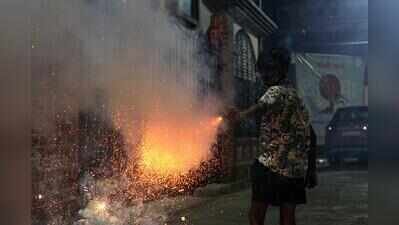
Kolkata: Bursting of crackers in some south and central Kolkata pockets over the last few nights has been leading to ‘neighbourhood smog’, often referred to as localised or urban smog — a high concentration of ground-level air pollution confined to a specific neighbourhood, residential zone, or local community. It has been leading to coughing fits and aggravating lung diseases like asthma and COPD, said physicians even as several hospitals have seen a rise in patients with sudden respiratory distress since Wednesday night.A south Kolkata hospital has been swarmed by such patients over the last few days, prompting it to release an awareness video on social media, in which doctors have spoken on the ill effects of cracker smoke.Unlike broad regional smog that covers an entire metropolitan area uniformly, neighbourhood smog is heavily driven by hyper-local emission sources and localised microclimates, leading to micro-hotspots of poor air quality within a specific area, said experts. “It helps to trigger and aggravate lung conditions like COPD and asthma, other than causing long-term damage to the lungs. That apart, it creates a choking feeling within sleep since crackers are now being burst late into the night. Smoke filtering into the room is extremely harmful since it remains suspended in a closed space with windows mostly shut now,” said Charnock Hospital pulmonology head Soumya Sengupta.Neighbourhood smog infiltrates the lungs at point-blank range, said Debraj Jash, head of pulmonology at Manipal Hospital, Salt Lake and Broadway. “Crackers burst at ground level, right where people stand, so you get a concentrated dose before the smoke spreads. An Indian study measured personal PM2.5 exposure from six common firecrackers and concluded that burning them produces ‘extremely high levels of personal exposure to PM2.5.’ Researchers expect significant short- and long-term health effects from this,” said Jash.Neighbourhood smog forms through a combination of local emission sources, specific atmospheric chemistry, and local weather or geographic conditions that could also be triggered by residential heating, biomass burning, localised traffic congestion other than firecracker smoke.BP Poddar Hospital has seen a 20%–25% higher patient footfall, predominantly involving complaints of persistent cough, throat irritation, wheezing, chest tightness and worsening breathlessness over the last three days. “Patients with COPD, chronic bronchitis, asthma or allergic airway hypersensitivity are particularly vulnerable. Even previously stable patients may experience acute exacerbations requiring medical intervention. Such individuals should continue prescribed maintenance medications, keep rescue inhalers readily accessible and follow condition-specific preventive advice,” said Rik Banerjee, BP Poddar Hospital consultant pulmonologist.He added that with more firecrackers expected, a further rise in respiratory cases is expected. For vulnerable patients, seemingly mild symptoms can escalate quickly. “Firecracker smoke contains fine particles, sulphur dioxide and nitrogen oxides that can aggravate coughing and breathlessness. Lung cancer patients with coexisting COPD are particularly vulnerable because their lung function is already impaired. While long-term exposure to air pollution increases lung-cancer risk, even a brief pollution spike can worsen symptoms in these patients,” said Sayoni Bhanja, consultant, medical oncology, HCG Cancer Centre, Kolkata.