







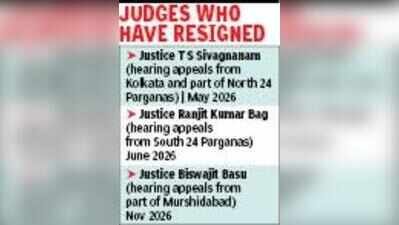
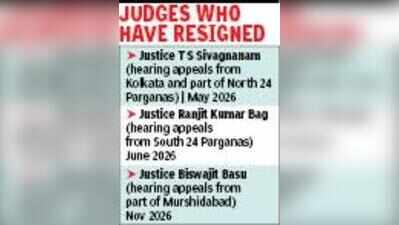
Kolkata: Retired judge Biswajit Basu, one of the judges of SIR tribunals who was hearing appeals by voters from a part of Murshidabad, stepped down on Saturday citing “personal reasons”.Basu is the third judge to resign from the tribunals set up by Supreme Court to hear appeals by voters whose names were struck off electoral rolls during Special Intensive Revision (SIR).His resignation puts the fate of voters from Murshidabad, the district with the highest number of appeals, into further uncertainty. Basu was one of the two judges hearing appeals by voters from Murshidabad that had over 7.4 lakh appeals pending when Election Commission submitted a report in Supreme Court in Sept.Justice Indrajit Chatterjee, the other judge who is hearing appeals by voters from Murshidabad, had also written to the EC saying he would step down because of difficulty in commuting and issues with the portal where judges were recording their decisions. Chatterjee subsequently decided not to resign after EC promised changes in the portal.“I have resigned from my duties of SIR tribunals. The resignation is for personal reasons,” Basu said on Saturday.Former Calcutta High Court Chief Justice TS Sivagnanam was the first of the tribunal judges to step down. He was hearing appeals by voters from Kolkata and parts of North 24 Parganas. Justice Ranjit Kumar Bag, who was hearing appeals from South 24 Parganas, also stepped down.Basu was appointed the chairperson of Institutional Corruption Commission set up by the BJP govt to probe corruption within institutions. Basu also heads the West Bengal Clinical Establishment Regulatory Commission, which hears complaints of excess billing and some other irregularities by private hospitals.The SIR tribunals have not been examining appeals since Sept 21 as judges refused to log in to the new portal introduced by EC. The judges had earlier objected to EC’s portal restricting them to considering only 13 documents while disposing of appeals. They said the new portal violated the legal mandate. SC had in March 2026, while ordering the formation of tribunals, noted the 13 EC-specified documents that can be considered for adjudication. It, however, clarified that the list was “indicative”, not “exhaustive”. The judges had then said they were a quasi-judicial authority under the order of Supreme Court and were “free to consider any documents which appear to be relevant and acceptable for the purpose of proper adjudication of the appeal.”The stand-off had led to a situation in which no SIR tribunal judge had been able to upload a single order for over a month.