










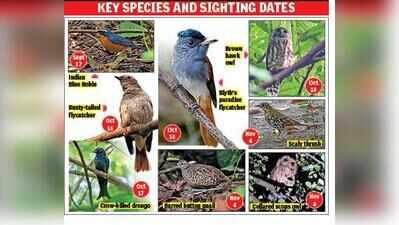
Kolkata: Birdwatchers at Rabindra Sarobar say this autumn has been one of the most promising in recent memory, with rare sightings of rusty-tailed flycatcher, Indian blue robin, Blyth’s paradise flycatcher, crow-billed drongo and scaly thrush raising hopes of an exceptional winter birding season.Sandeep Biswas, an eBird reviewer and bird identification expert, said Rabindra Sarobar lies along migration flyways used by birds travelling from north India and Eurasia towards south and south-east Asia. “Sarobar hosts resident birds, local seasonal birds, winter migrants and passage migrants. Oct and Nov are especially important because bird activity peaks during this period,” he said.This year has also brought additions to the resident bird list, including brown hawk owl and collared scops-owl, the latter reported for the first time at the lake. Sudip Ghosh, an IT professional and birder, said around 15 notable species had been recorded recently, including five first-time sightings.Regular birders say the improvement reflects a larger ecological recovery, especially since restrictions were imposed on large gatherings inside the lake premises. Debjit Mukherjee, who works in IT and has documented the tree diversity of Rabindra Sarobar, said bird numbers on the islands have increased over the past seven years. painted stork and grey heron populations, he said, have shown encouraging growth.Mukherjee estimates that Sarobar has 135 to 140 varieties of trees, including rare parul trees. But he warned that recent “beautification” efforts are damaging the habitats that support birds, insects and other wildlife. “There were saplings of parul that were cleared. Firefly habitat near the Durga Museum has been destroyed. Leaf blowers are being used in key birding zones, adding to noise and disturbance,” he said.“Let 20% of the area remain wild and maintain the rest. Bird and insect life thrives when there is natural growth, not excessive manicuring,” Mukherjee said.Birders are particularly concerned about any move to allow Chhath Puja inside Rabindra Sarobar. Before curbs, they said, large crowds, firecrackers, sound systems and smoke disturbed wildlife, while offerings polluted the water and contributed to fish and turtle deaths.Adhirup Ghosh, who has recorded more than 1,000 bird species in India, said allowing Chhath Puja at Sarobar would be “a death penalty” for the environment.“This is the time when bird activity is at its maximum and migratory birds arrive at Rabindra Sarobar. If Chhath is allowed now, we are afraid we will lose the birds for good,” he said.Priyam Chattopadhyay said sightings have increased but many migrants are staying only briefly. “There is disturbance in the habitat inside Lion’s Safari Park. The use of leaf blowers to keep the paths clean is adding noise in the main habitat,” he said.