












NEW DELHI: Last week, Chief Justice of India Surya Kant expressed exasperation over the growing number of “digital arrest” scams, questioning how even educated people continued to fall victim to them despite repeated public awareness campaigns.“What is wrong with these victims? How are these victims being trapped like this? They can’t understand this basic thing? What’s the fear of arrest on mobile?” the CJI orally observed while hearing a suo motu case on digital arrests.“Hit the mobile on the wall and arrest goes. Something is wrong with people. God knows what is there. What kind of person are you in a democratic country if you think you are getting arrested on mobile?” he added.But is it really that simple?Every day, people across the country fall victim to these scams. It often begins with an unfamiliar voice on the phone, claiming that the person has been implicated in a crime. What follows is a carefully orchestrated web of threats, intimidation and psychological manipulation, with victims drawn deeper into the trap over phone and video calls.
No legal basis for digital arrest
As society evolves, so does crime. While traditional theft involved breaking into homes, cracking safes or carrying out armed robberies, the expansion of digital technology has opened up new avenues for criminals. Increasingly, fraudsters no longer need to come face to face with their victims to rob them.Digital arrest is one such sophisticated form of cyber fraud. Criminals impersonate police officers or officials of investigative agencies, convincing unsuspecting people that they are under investigation for serious offences.
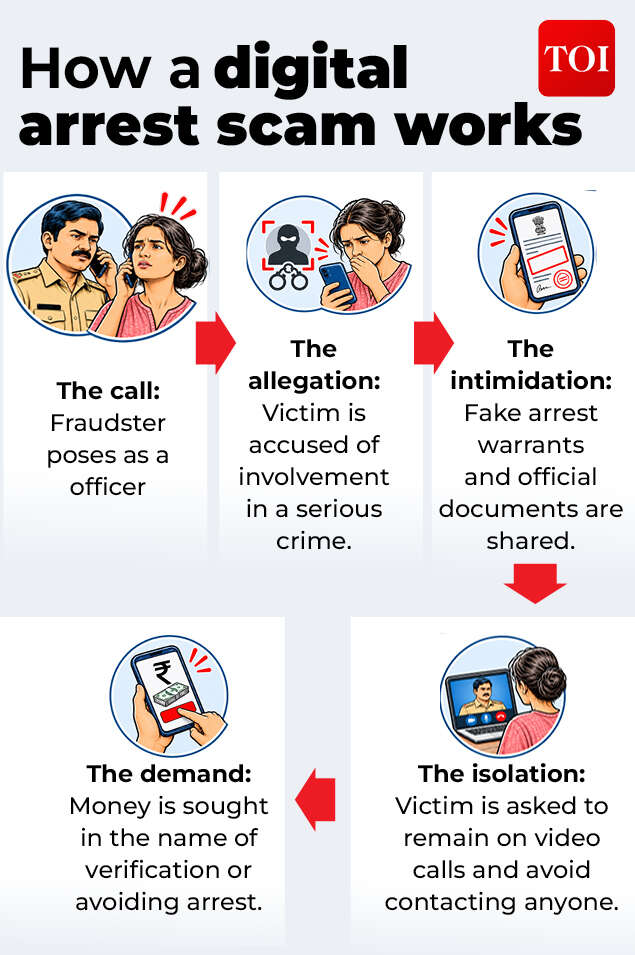
Typically, the scam begins with a phone or video call in which fraudsters claim that the victim’s identity has been linked to crimes such as money laundering, drug trafficking or other illegal activities.Victims are then made to believe that they are under constant surveillance and instructed to remain on video calls for hours, sometimes even days, without contacting family members or anyone else. To lend credibility to their claims, scammers often produce forged arrest warrants, court orders and official-looking identity documents, making the threat of legal action appear genuine.The intimidation eventually gives way to demands for money. Victims are instructed to transfer funds to designated bank accounts for supposed verification, security clearance or to avoid arrest.But digital arrest has no legal basis. No law enforcement agency can arrest someone over a video call or demand money to prevent prosecution. Nor do authorities issue or serve arrest warrants through video calls, WhatsApp, emails or other messaging platforms.
The magnitude of digital arrests
The scale of the problem is reflected in government data. According to a 2025 response in the Rajya Sabha, reported digital arrest scams and related cybercrimes in India nearly tripled between 2022 and 2024, while the amount defrauded increased more than 21-fold.Replying to a parliamentary question, minister of state for home affairs Bandi Sanjay Kumar furnished data on digital arrest scams and related cybercrimes reported on the National Cybercrime Reporting Portal (NCRP) over the three-year period.
The data showed that 39,925 incidents were reported in 2022, involving a total defrauded amount of Rs 91.14 crore. By 2024, the number of reported incidents had risen to 1,23,672, while the amount defrauded had surged to Rs 1,935.51 crore.The growing sophistication and scale of these scams have also drawn the attention of the Supreme Court.In October 2025, the court took suo motu cognizance of the issue after a senior citizen couple from Haryana approached it, alleging that fraudsters posing as investigative agency officials had cheated them of more than Rs 1 crore using forged court documents.Investigations have also brought into focus the organised networks operating behind these frauds, including syndicates based overseas. A major challenge for investigators is tracing the money trail, with criminals using intermediary or “mule” bank accounts to receive stolen funds and rapidly transfer them across multiple accounts to evade detection.
More than digital, it’s psychological
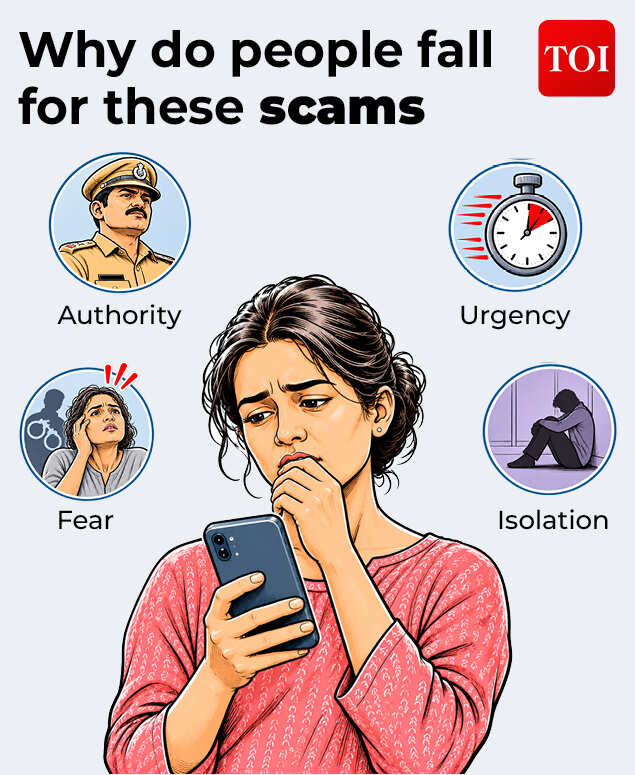
The persistence of these scams raises an important question: Why do some people fall for something that may appear obviously fraudulent to others?Speaking to The Times of India, clinical psychologist Yukta Sharma said phishing and cyberfraud should not be dismissed as instances of poor judgement. Instead, they exploit ordinary human responses to fear, uncertainty, authority and the promise of rewards.“Phishing is not merely a technological problem. The technology provides the medium, but the actual vulnerability being exploited is often human psychology,” Sharma said, adding that even people who are intellectually well-equipped can fall prey to such traps.
According to her, scammers deliberately create situations designed to provoke an immediate emotional response. This could be fear of losing money, anxiety over possible legal consequences, excitement about a potential reward or trust in someone posing as an authority figure.“When an individual is being targeted through a phishing attempt, there is often a complex interplay of emotional arousal, cognitive processing and decision-making taking place. These attacks deliberately create situations that trigger an immediate emotional response, whether it is fear of losing money, anxiety about legal consequences, excitement over a potential reward or trust in an apparently legitimate authority,” she said.“Once these emotions are activated, the individual’s attention tends to become increasingly focused on resolving the perceived situation rather than questioning its authenticity,” Sharma told TOI.She explained that victims may move gradually from initial suspicion to compliance as fraudsters build credibility through convincing explanations, repeated instructions and sustained pressure.By the time the deception is exposed, victims are often left dealing with shock, disbelief, guilt, embarrassment and anxiety. The experience can be particularly distressing because they may struggle to understand how they were manipulated into surrendering their money.
India’s fight against digital arrests
A NITI Aayog report describes cybercrime in India as having evolved from a “distant threat into a pervasive everyday reality”. Recognising the growing challenge, the Centre has stepped up efforts to combat digital fraud and strengthen the country’s cybercrime response.One of the key initiatives is the Indian Cyber Crime Coordination Centre (I4C), established by the ministry of home affairs to coordinate national efforts to tackle cybercrime and support its prevention and investigation.
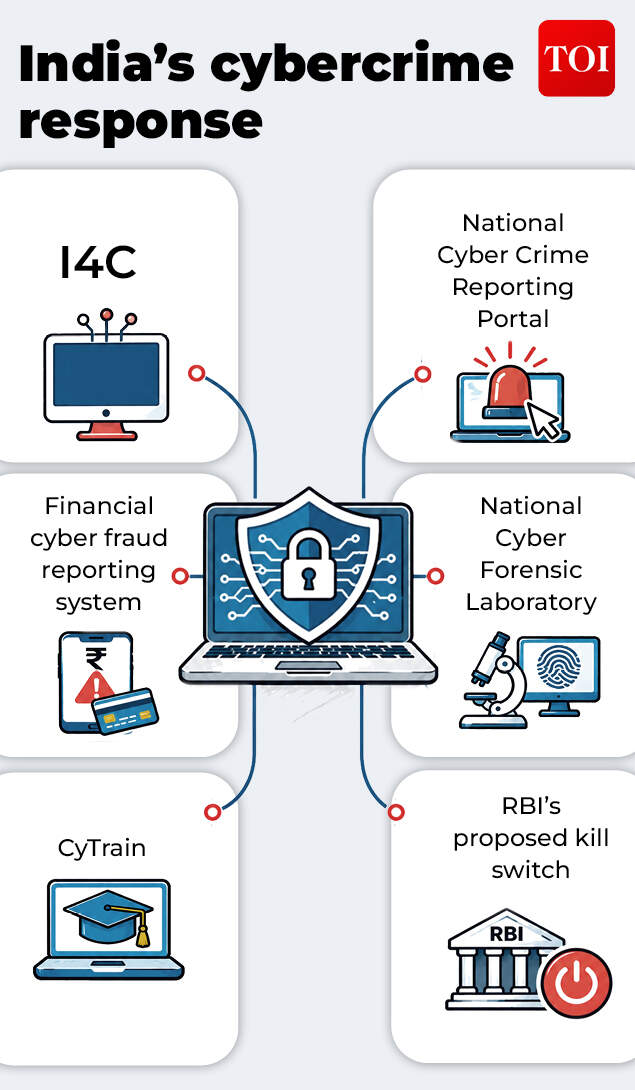
To address financial cyber fraud, the government launched the financial cyber fraud reporting system in 2021, enabling victims to report incidents quickly. According to the report, the system has helped save more than Rs 3,431 crore across 9.94 lakh complaints.The government has also strengthened cyber forensic capabilities through the National Cyber Forensic Laboratory in Delhi and the Evidence Lab in Hyderabad, enhancing the ability of law enforcement agencies to examine and analyse digital evidence.The I4C’s online training platform, CyTrain, meanwhile, aims to equip police personnel and judicial officers with the skills required to investigate and prosecute cybercrime.The Reserve Bank of India is also exploring the possibility of introducing a ‘kill switch’ mechanism that would allow potential victims to immediately block all financial transactions from their accounts.But are these measures enough to keep pace with increasingly sophisticated cybercriminals?Former Bihar director general of police Abhyanand believes digital arrest scams must be treated as serious cases of organised cheating, requiring a specialised and professional police response.Speaking to TOI, he said cybercrime has traditionally been one of the weaker areas of policing, largely because perpetrators are difficult to trace and may operate across state or international borders.
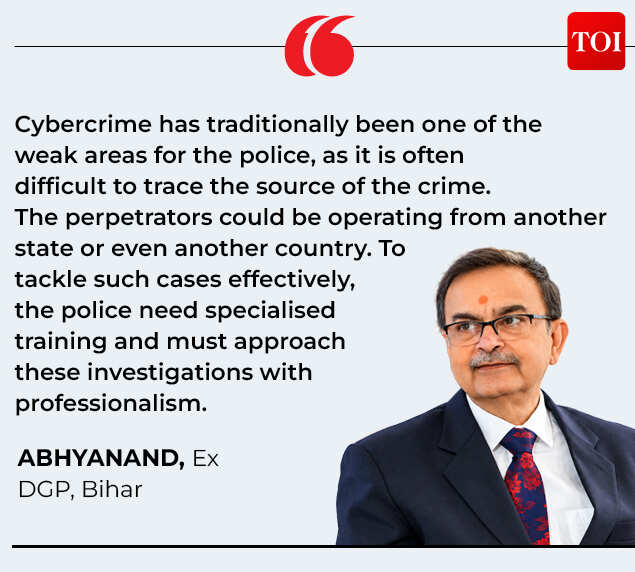
“Digital arrest is a sophisticated form of cheating and the police must treat it as such. It is a combination of cybercrime and traditional fraud. Cybercrime has traditionally been one of the weak areas for the police, as it is often difficult to trace the source of the crime. The perpetrators could be operating from another state or even another country,” the former DGP said.“To tackle such cases effectively, the police need specialised training and must approach these investigations with professionalism,” he added.Cyber and privacy law expert advocate Prashant Mali, meanwhile, argued that India needs stronger financial surveillance, more accountable telecom infrastructure and faster action against fraudulent accounts to tackle the menace.“I feel we need stronger financial surveillance, accountable telecom infrastructure, faster freezing of fraudulent accounts, international cooperation and effective law enforcement,” Mali told TOI.He also criticised the lack of effective deterrence against cybercriminals, arguing that convictions in cybercrime cases remain in single digits.
“I feel government is not able to create deterrence in the minds of cyber criminals engaged in the brutal digital arrest, cyber crime. We need to make an example of the crime digital arrest related convictions, but the convictions in cybercrime matters are in single figures,” he said.Mali also proposed a government-backed insurance mechanism to protect victims of digital fraud, arguing that the financial burden should not fall on those who have already been cheated. “I feel government asked for digital India as the flagship program. Now digital arrest is the fallout where unsuspecting victims are falling prey to fraud. We need digital India insurance for digital arrest victims where the premium is paid by government and banking, financial services, and insurance participants and not by the victim. Every Indian should be secured from a digital accident like the digital arrest by Digital India Insurance,” he suggested.
Share your thoughts in the comments
Be respectful · TOI community guidelines
As India pushes ahead with its digital transformation, cybercriminals are finding increasingly sophisticated ways to exploit the same technology. The fight against digital arrest scams, therefore, cannot rest on awareness campaigns or individual vigilance alone. It will require better-trained police forces, stronger financial safeguards, faster investigations and a system that can respond as swiftly as the fraudsters operate.The CJI’s question about why people continue to fall for these scams is important. But the answer lies not simply in telling victims to be more careful. It lies in understanding how fear and manipulation can override rational judgement, and building institutions capable of protecting people when that happens.