










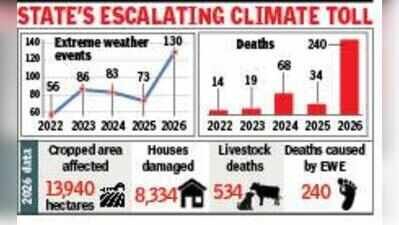
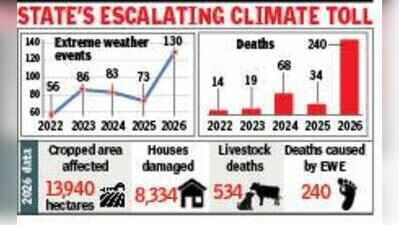
Kolkata: Bengal has emerged as one of the most severely affected states in India’s escalating extreme weather crisis, with 240 people losing their lives in the first nine months of 2026 — a sevenfold increase over the 34 deaths recorded during the corresponding period last year. The state experienced extreme weather events on 130 days between Jan and Sept, compared with 73 days in 2025, according to Climate India 2026: An Assessment of Extreme Weather Events, released by Centre for Science and Environment (CSE).The report paints an alarming picture of Bengal’s growing exposure to climate extremes, with heavy rainfall, thunderstorms and lightning emerging as the biggest killers. The number of days affected by extreme weather has more than doubled — from 56 in 2022 to 130 in 2026 — while the death toll has surged from 14 to 240 during the same Jan-Sept period.Heavy rainfall, floods and associated disasters accounted for 124 deaths across 85 days, making them the deadliest category. Lightning and thunderstorms struck on 71 days, claiming 112 lives. Heatwaves, recorded on two days, caused four deaths while the state experienced one day of cold-wave conditions.Beyond the human toll, the disasters affected 13,940 hectares of cropped land, damaged 8,334 houses and killed 534 livestock, underlining the growing economic vulnerability of rural communities.The figures suggest that Bengal is confronting a combination of increasingly frequent weather extremes and mounting human losses. The sharp rise in fatalities is particularly worrying because it comes despite improvements in weather forecasting and early-warning systems.Nationally, extreme weather events occurred on 251 of the 273 days between Jan and Sept 2026 — nearly 92% of the period — claiming 3,320 lives, according to CSE’s assessment.CSE director general Sunita Narain described the disasters as the human face of climate change. “The world has failed to limit temperature rise to 1.5°C,” she warned, adding that breaching this threshold would intensify the climate emergency and bring worse impacts in the coming years.However, the recorded losses may represent only a fraction of the actual devastation. Richard Mahapatra of CSE warned that the official assessment suffers from serious underreporting because most states lack rigorous systems to document disaster-related deaths and damage. “States do not provide data regularly and so, the data is not comprehensive,” Mahapatra said.He pointed out that while weather bulletins can establish the frequency of extreme events, the absence of a robust public database makes it difficult to assess their actual impact.The findings raise urgent questions about Bengal’s disaster preparedness, climate adaptation strategies and the need for a comprehensive system to document losses, particularly among vulnerable rural communities.